

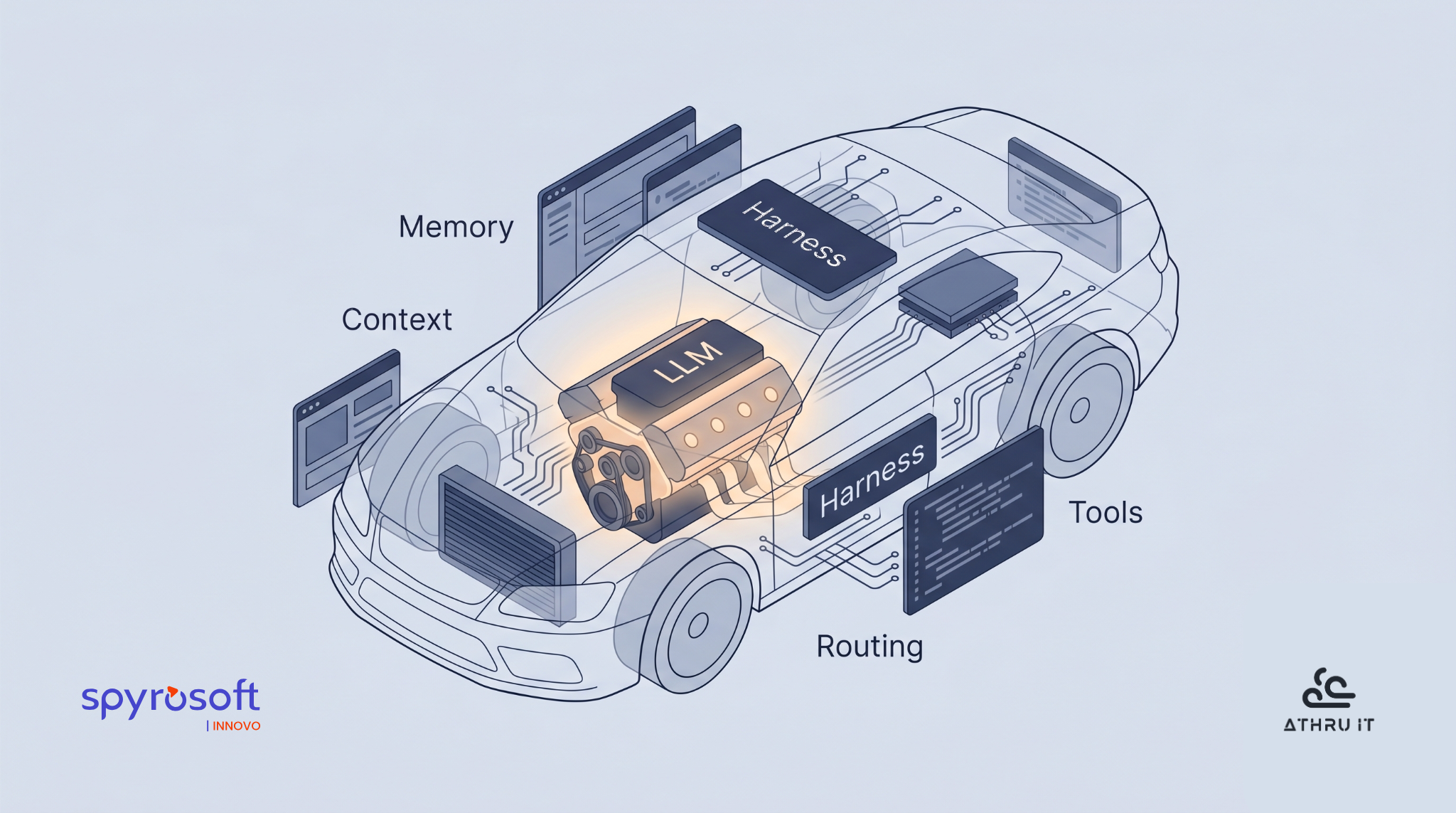
The Interface You Rent
This morning, someone on your team opened Claude.ai, typed a question, and got an answer. They said they used AI. They didn't.
They used an AI harness - a layer of software Anthropic built on top of a language model. The model, Claude Opus 4.7, was underneath, doing one thing: receiving text and returning text. Everything else - the conversation history, the context injection, the system prompt shaping how it responds, the interface they typed into - that was the harness. Anthropic's harness. Not theirs.
ChatGPT is a harness. Gemini is a harness. Claude.ai is a harness. The models powering them (GPT-5, the Gemini family, Claude Opus 4.7) are the engines underneath.
What is an AI harness, exactly? And why does it matter that you don't own the one you've been using?
The LLM vs. the Harness
Strip away the interface and what you have is a text predictor.
A language model receives a sequence of tokens and returns the statistically likely next tokens. That is the full extent of what it does in isolation.
A language model is not an agent. It's a text predictor.
It has no persistent memory, no ability to call external tools, no context management, no routing logic, and no way to take action in the world.
It doesn't know your name unless something tells it your name. It doesn't remember last week's conversation unless something injects that history. It has no access to the current date, your organization's documents, your calendar, or anything outside the text you hand it this instant. The AI harness vs LLM distinction isn't conceptual. It's functional.
The LLM abstraction layer - the harness - exists to supply everything the model cannot. Memory. Context. Tool access. Routing. Response handling. The model does one narrow thing well. The harness makes it useful.
If the model can't do any of that, something else has to. That something is the harness.
What an AI Harness Is
The cleanest definition comes from Dave Beckett:
The model is the engine. The harness is the car.
The engine makes motion possible. The car makes motion useful - steering, brakes, windows, a destination. You never interact with the engine directly. The car is everything you actually use.
That AI wrapper vs model framing captures the relationship precisely. LangChain's formulation, widely cited across the practitioner community:
Agent = Model + Harness.
The model contributes raw prediction capacity. The harness contributes everything required to turn that capacity into a functioning product.
MindStudio describes what this looks like in practice:
language models wrapped in carefully designed harnesses that handle perception, planning, tool use, memory, and execution.
Each of those words - perception, planning, tool use, memory, execution - names a function the model cannot perform alone.
Birgitta Böckeler, in a guest post on martinfowler.com, organizes harness components into two categories: Guides (feedforward inputs that shape what reaches the model - system prompts, retrieved context, tool definitions) and Sensors (feedback mechanisms that monitor what comes out - output validators, cost trackers, safety filters). That taxonomy covers both prompt orchestration and context management AI: the harness manages both sides of the exchange.
Critically:
[harnesses] do not alter the LLM's internal weights or training - they're architectural software surrounding the model, not modifications to it.
The model doesn't change. The harness shapes everything around it.
The harness is the infrastructure. The model is inside it.
You've Already Been Using One
The products you reach for every day are commercial harnesses.
ChatGPT is a harness - OpenAI's, built on GPT-5. Claude.ai is a harness - Anthropic's, running on Opus 4.7. Gemini is Google's harness. Cursor is a harness. Claude Code is a harness. Codex is a harness. The underlying models are the engines. The products you interact with are the cars.
When you type into ChatGPT, the context management, the system prompt, the memory, the tool integrations, the conversation routing - that is AI agent infrastructure OpenAI designed and owns. You didn't build any of it. You don't control any of it. When OpenAI decides to change how context works, deprecate a model, or restructure pricing, your workflow adjusts around their decision.
The user experience, the memory design, the safety filters, the model selection - these are Anthropic's choices, Google's choices, OpenAI's choices. You sit inside someone else's car, using their controls, going where their harness lets you go.
This is not an indictment. Commercial harnesses are well-engineered, fast to adopt, and often the right tool for the job. The point is simpler: you have been using a harness all along. You just didn't know it was called that. And you don't own it.
You do not have to keep using someone else's harness.
Building Your Own Harness
You don't need access to model internals. You don't need a partnership with a lab or a proprietary license. You need the model's API.
That's the threshold. Any engineering team that can call an API can build a harness.
The more consequential question is what you'd build it for. A commercial harness is optimized for the median user across millions of accounts. Your harness can be optimized for you - your use case, your data, your hosting environment, your latency tolerances, your compliance requirements, your budget. None of those are design inputs anyone else can tune for you.
The performance gap between a tuned harness and a generic one is real. Per S005, swapping only the harness - without changing the underlying model - moved Claude Opus 4.5's CORE-Bench score from 42% to 78%. LangChain separately documented moving an agent from outside the top 30 to the top 5 in its category through harness changes alone, without touching the model. The model was the same. The harness made the difference.
What is harness engineering, at its core? It is the discipline of designing the software layer around the model - the prompts, the context strategy, the memory architecture, the tool integrations, the routing logic - to extract the maximum performance from a given model for a specific task. The distinction is clean: prompt engineering gets you a better single response; harness engineering gets you a better system.
To build your own AI harness is to build that system once, own what you've built, and stop adjusting your constraints to fit someone else's product.
The Ownership Argument: LLM-Agnosticism and Vendor Independence
A well-designed harness treats the model as a swappable component. The LLM API wrapper calls a model via API; the model is not baked into the logic. Adjust a configuration parameter - point the call at a different endpoint - and the harness runs on a different model. That is what a model-agnostic AI system looks like in practice.
This is where renting a harness costs you most.
When you use ChatGPT, your conversation history, your system prompt design, your context management strategy, and your application integrations all live inside OpenAI's infrastructure. Switching to a different model or product means you are not porting a harness - you are rebuilding from scratch. The switching costs are real: governance decisions, application connections, context tuning, prompt calibration - all of it must be reconstructed in the new environment.
The structural case against AI vendor lock-in doesn't need a statistic. It needs one observation: models improve fast. The capability gap between the leading models has closed rapidly.
The model is increasingly a commodity. GPT-4o, Claude, and Gemini are interchangeable reasoning engines at the harness layer.
When you own the harness, you point it at whichever model has the best cost-performance curve this quarter. When you rent the harness, you take whatever model the vendor has decided to bundle with their interface.
Dave Beckett's formulation is the sharpest version:
Models may become commodities. Harnesses are the product.
The layer becoming commoditized is the one you're renting. The layer becoming product is the one you could own.
Own It or Keep Renting
The harness is not something you add to AI. It is the thing you have been using all along.
Every time you open a chat interface - Claude.ai, ChatGPT, Gemini, Cursor - you are running a harness. The question was never whether you need one. You have always needed one. The question is who owns it.
A commercial harness is fast to adopt, well-maintained, and optimized for a general audience. If that's what your team needs right now, that's a legitimate call. But know what you're choosing: someone else's context strategy, someone else's memory design, someone else's switching costs when their pricing or model strategy changes.
A custom harness runs where you want, costs what your compute costs, and points at whichever model serves your use case this week. You see the full path from user input to model output. You own the logic.
Harnesses are the product.
You're already using one. The only open question is whether it's yours.