

TL;DR
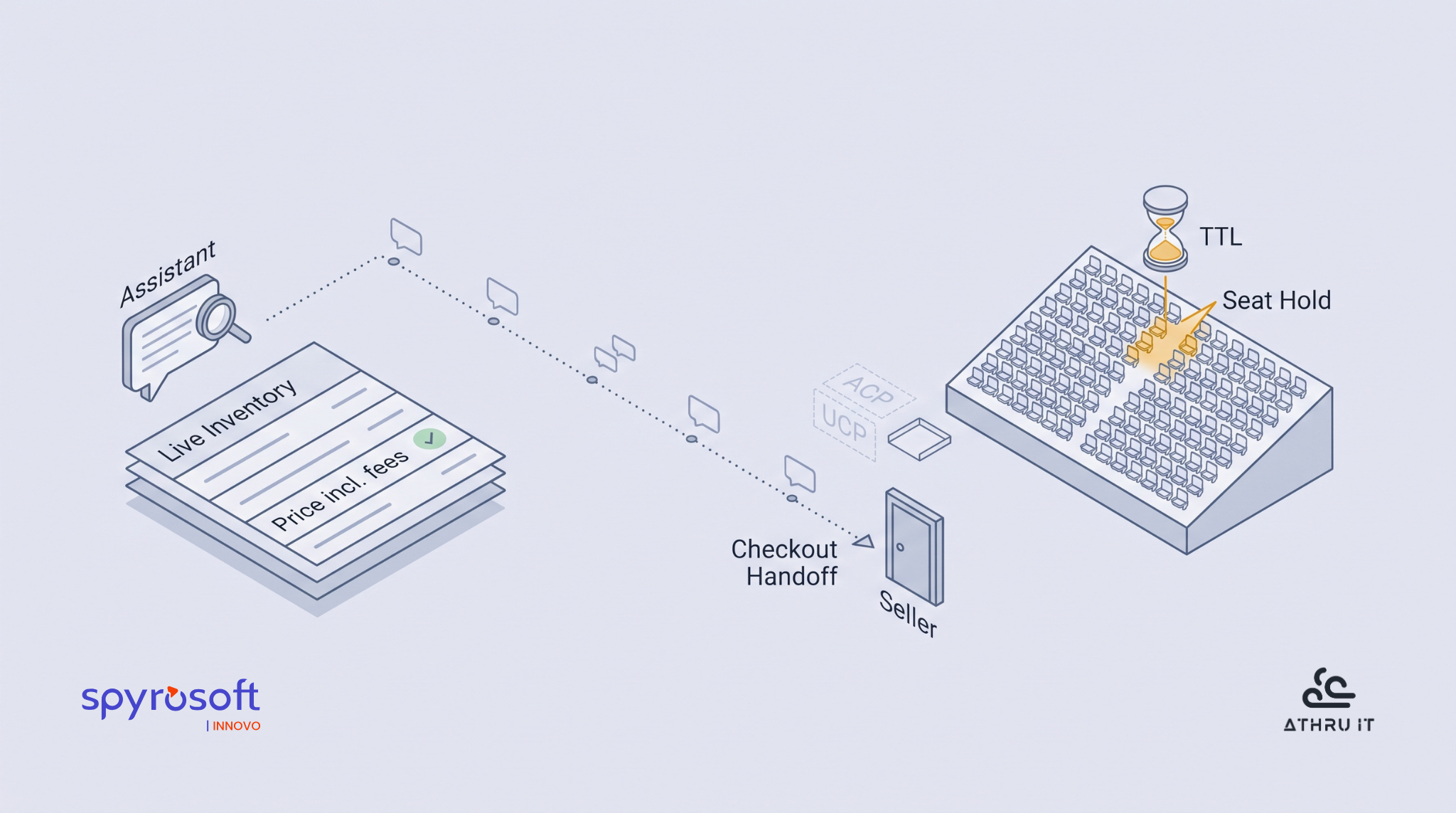
Agentic commerce in ticketing means an AI assistant finds an event for a fan and, today, usually sends her to the seller's checkout to buy. Three tests decide whether a European shop works in that flow. To be found, a shop must expose live inventory and a fee-inclusive price that an agent can read. To stay bookable while the fan decides, the shop needs a seat hold that lasts, which the open protocols assistants buy through do not yet carry.
Fans are starting to ask an assistant first
A fan asks an assistant for two seats on Saturday night. The assistant searches, compares and suggests. Your shop is either in that answer or it is not.
That is agentic commerce in ticketing: an AI assistant, acting for the fan, finds an event, checks what is on sale and moves the fan towards a purchase. The fan may never open a search engine, and may not see your homepage until the checkout.
For a European ticket shop, being in that answer depends on what an agent can read from your own feed.
Agentic commerce in ticketing: assistants find, sellers check out
Ticket discovery in AI assistants already has a shape. As of October 2026, it looks like this:
- ChatGPT: Ticketmaster's app, announced in April 2026, lets fans discover events and explore ticket options inside the chat.
- Claude: Ticketmaster's connector, announced in July, retrieves eligible event information and ticket availability.
- Gemini, Ticketmaster: the app is live in English for users in the US, by Ticketmaster's own account, and will scale to more languages and markets over time.
- Gemini, Fever: its app, announced in August, is also in English for US users first, with other markets to follow over time.
Ticketmaster says its ChatGPT and Claude integrations are available to fans in more than 20 countries. Fever also runs an event-discovery MCP (Model Context Protocol) server that connects compatible assistants, Claude among them.
In each case, the assistant finds the event and checks what is available, and the fan finishes the booking on the seller's own checkout, with the chosen seats already selected in Ticketmaster's Gemini app. Where a fan can do this depends on the integration and the assistant, not on one list of countries.
Your stock needs a standard vocabulary and a connector an agent can call
Every one of those bookings starts with the assistant reading someone's stock. The first test is whether it can read yours: live inventory in a vocabulary an agent already knows, behind a connector it can call.
The vocabulary exists. In schema.org Event, an event happens at a certain time and location, such as a concert, lecture or festival. For an agent, three of its fields do most of the work: ticketing information goes in its offers property, the start date says when, and eventStatus marks an event that is cancelled or rescheduled. This structured event data makes your listing readable in a standard form.
The connector is the other half. MCP is an open protocol that connects large language model (LLM) applications to external data sources and tools. A server built on it offers an assistant resources (context and data), prompts, and tools (functions the model can run). Before an assistant invokes one of those tools, the host application must obtain the user's explicit consent. That keeps the fan in the loop when an agent acts for her.
An MCP connector lets an assistant ask your system what is on sale now, not what a page said yesterday. Fever already runs an event-discovery server of this kind for compatible assistants.
If you run ticketing for many shops as a platform operator, what we call an enabler, this test is yours to pass. Each shop on your platform is a tenant, so expose the tenant feed once, through one structured model and one connector, and every tenant on it becomes readable at the same time. No shop has to build its own.
The price an agent quotes must already include the fees
Whoever builds the feed, the number in it matters as much as the stock. The second test is whether the fan will pay the price an agent quotes.
Google already asks for this in its event results. In the regions it covers, which in Europe are Germany, Spain and the United Kingdom as of October 2026, it requires the lowest available price for your tickets, including service charges and fees. Other EU markets, such as France and Italy, are not on that list. Google also expects the event to use schema.org's event types, with the price carried in the event's offers.
An agent that quotes a price without fees sends the fan to a higher total at your checkout. A fee-inclusive price in the feed means the assistant's answer and your basket agree.
The assistant hands the fan back because only the platform owns the whole path
An assistant that reads all of this still sends the fan to you to pay. Platforms keep the checkout for a plain reason: they own what happens there. Softjourn, which builds ticketing software, sets out the case: the handoff to checkout keeps the seat, the payment and the buyer's identity on infrastructure the platform already runs.
By Softjourn's account, the agentic commerce protocols, the open standards that let an assistant buy on a shopper's behalf, were written with warehouse goods in mind, where any unit is as good as the next. A seat is not. Softjourn also found that ticketing never reached in-chat checkout in the assistants it studied, and that the assistants' buying programmes start in the US and remain largely US-only for now.
In the EU and the UK, payment rules add a second reason. Strong customer authentication makes the bank's extra check a routine part of online card payments, which tilts the case towards a checkout the platform controls. The payments consultancy Edgar, Dunn & Company argues that an AI agent cannot, on its own, provide the two independent factors that check needs.
The default has moved both ways. OpenAI launched its own in-chat checkout, Instant Checkout, in September 2025, then in March 2026 let merchants use their own checkout while it focused on product discovery, keeping the feature in ChatGPT apps for the time being.
Ticketmaster on Alexa+ is a different case. Fans in the US can buy tickets there without ever leaving the assistant, but that is a bespoke integration, in which one platform owns the whole path from account to payment. Everyone else has to rely on the open protocols, and they do not yet carry the seat hold.
The seat hold that open protocols do not yet carry
The fan likes the seats and wants to check with a friend first. By the time she replies, the seats may be gone.
That is the third test, and it is where the work sits. A reserved seat is held for a short time while the buyer decides. On your own site, the hold and the checkout live in one session. In an assistant, the decision stretches across a conversation, and the hold has to survive it.
An assistant checks out through open protocols such as ACP (the Agentic Commerce Protocol, started by OpenAI and Stripe) and UCP. In Softjourn's analysis, neither ACP nor UCP has an operation to hold, reserve or lock inventory. Both represent checkout expiry, but neither protocol's main checkout schema defines a separate seat hold with its own timer. The assistant gets a price and a session ID, and a held seat can expire in the middle of the conversation. The agent cannot see the clock, and neither can the fan.
The nearest open work points the right way without reaching seats. UCP, the Universal Commerce Protocol, is developed in public, and its charter for local services, opened in October 2026, is still an open proposal. It covers holds with a time to live (TTL): each hold lapses after a set period, so two agents cannot take the same slot.
Its first phase covers bookable services, with reservations in a later phase, and its scope includes group sessions for capacity-limited classes and events. That may suit general admission or timed entry, and the charter points to a separate, earlier proposal on booking availability for timed entry. Reserved seats and seat maps are outside its scope.
Delegated checkout, where the agent completes the purchase on the fan's behalf, depends on exactly this. It needs a seat hold that the agent can see and that outlives the conversation that started it. Until a standard carries one, that hold is something your own platform has to expose.
Agent-ready ticketing starts with three tests on your own shop
You can run the three tests on your own shop now, without waiting for a standard:
- Ask an assistant about one of your events and see what it finds.
- Check whether the price it could read includes your fees.
- Hold a seat and ask how long an agent could keep it.
Whichever test fails first is where agent-ready ticketing starts for you. For a platform operator, what we call an enabler, the answer covers every tenant at once.