

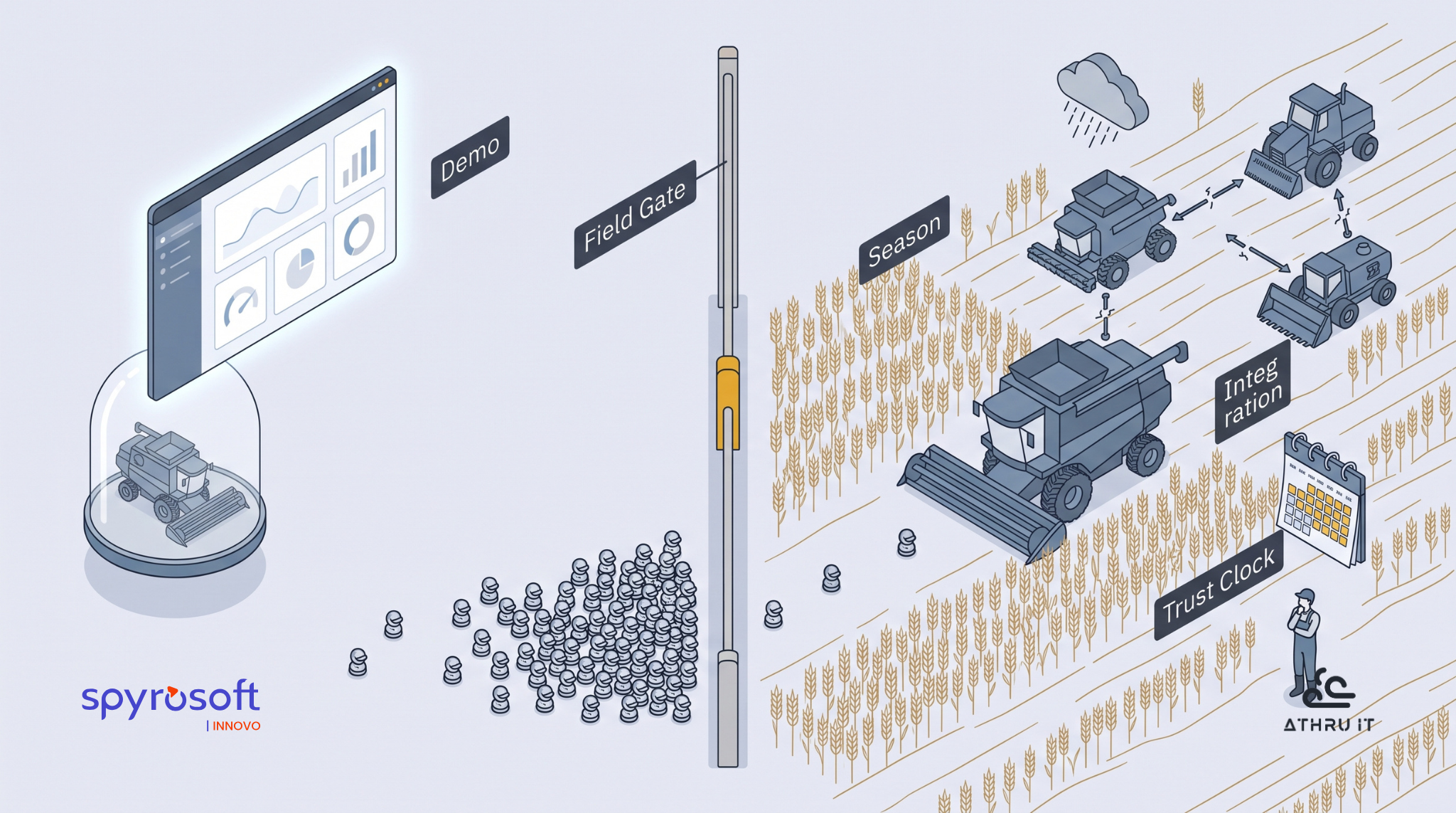
The Demo Is the Trap, Not the Milestone
The demo worked. The dashboard looked clean, the predictions landed within a reasonable margin, and the team walked out of the conference room convinced they had something. What they had was a starting gate, not a finish line.
Agritech AI pilot failure almost never happens in the lab. It happens at the field gate - the point where demo conditions meet the actual farm: seasonal variability, multi-brand equipment, patchy connectivity, and an agronomist who has seen three vendor promises come and go. The demo room is a controlled environment. The field is not.
Purdue's 2026 Agribusiness Review puts a number on the gap. Of 281 agribusiness leaders surveyed, 72% believe AI will improve their productivity. 5.5% report AI is well or fully integrated into their operations. That is not a technology problem. That is a field-gate problem.
The industry has spent the pilot era confusing demonstration with deployment. In 2026, the era is ending. The funding that underwrote promising pilots is tightening; investors and agribusiness boards are asking for operational results, not dashboard screenshots. What agtech AI pilot to production actually requires is not a better demo. It is a different discipline.
Our first article - "Agricultural Machinery Digitalization and AI: The Seven Software Layers the Industry Never Built" - mapped what is missing from the stack. This article is about what happens when an incomplete stack meets the season. The failure modes are not random. They are predictable. They are almost always visible before the pilot starts.
That brings us to the test. If you switched the system off tomorrow, would any farm KPI actually change? We will return to that question. First, the numbers.
The Numbers: Most Agritech AI Pilots Die - and the Death Is Systemic
This is not a few unlucky projects. It is a pattern documented independently across institutions and confirmed specifically in agriculture.
MIT's NANDA initiative studied 150 business leaders, 350 employees, and 300 public deployments for its "GenAI Divide: State of AI in Business 2025" report. The finding: approximately 5% of AI pilots achieve rapid revenue acceleration. The other 95% stall, delivering little to no measurable impact on the P&L.
IDC's research, conducted with Lenovo, found that 88% of AI proof-of-concept projects fail to reach production. Ashish Nadkarni, Group VP at IDC, put it in operational terms: for every 33 AI POCs a company launches, only four graduate to production. The rest die somewhere between the demo room and the field.
The World Economic Forum's 2025 "AI in Action: Beyond Experimentation to Transform Industry" report documented the pilot-to-production gap across industries at scale — confirming that the challenge of crossing from experimentation to transformation is not unique to agriculture.
In agribusiness, the pattern holds - and the gap is arguably wider. Purdue's 2026 Agribusiness Review found 72% of agribusiness leaders believe AI will improve their productivity, and roughly 80% expect it to strengthen operational resilience. Only 5.5% report AI is well or fully integrated into their operations. Agribusiness AI strategy stalled at exactly the transition every other sector gets wrong: the gap between believing in the technology and integrating it into the operation.
The industry's first response to that gap is almost always to interrogate the model. But it's a wrong question altogether.
The Misdiagnosis: Teams Blame the Model; Evidence Blames Data, Integration, and Workflow
When a pilot fails, the post-mortem almost always starts in the same place. What was wrong with the model? Was the accuracy off? Did the vendor oversell the capability? It is a reasonable question to ask. It is the wrong question to lead with.
Three institutions that studied this independently arrived at the same answer.
MIT's NANDA initiative found that when AI pilots stall, the failure is traced to workflow and culture integration gaps - not model quality. The model did what it was built to do. The organization had not built the conditions for it to matter. On an arable farm, those conditions take a full growing season to build - not a sprint.
IDC's research identified organizational readiness as the dominant bottleneck: data maturity, process design, and IT infrastructure - none of which are properties of the model. Ashish Nadkarni, Group VP at IDC, summarized the finding: for every 33 AI POCs launched, only four graduate to production. The attrition happens in the integration layer, not the algorithm. In agribusiness, the four that graduate must also survive their first full growing season before the result is even measurable.
KPMG's 2026 analysis of enterprise AI scaling reached the sharpest diagnosis:
"Enterprise AI does not stall because organizations lack ambition. It stalls when IT structural readiness is assumed rather than measured."
That is agriculture AI implementation failure in one sentence. The assumption that the model is production-ready is almost never the problem. The assumption that the organization is production-ready nearly always is.
Purdue's 2026 Agribusiness Review puts the organizational gap in concrete terms. 38% of agribusiness leaders surveyed use no Industry 4.0 technologies at all - or are unsure whether they do. Two-thirds are still exploring or considering adoption. That is not a technology-quality problem. The tools exist. The organizational infrastructure to receive them does not.
This misdiagnosis matters because it leads to the wrong fix. If the model is the problem, you change the vendor. If the organization is the problem, you change how you prepare. Agriculture inherits all of this - and then adds five structural features that make each failure harder to catch.
Why Agriculture Makes All of This Worse
Agriculture does not invent new AI failure modes. It takes the modes that kill enterprise AI projects everywhere and amplifies each one via five structural features that are predictable in advance.
The Seasonal Feedback Window
The first is the seasonal feedback window. In enterprise SaaS, a model that underperforms can be retrained in the next sprint. On an arable farm, a model that miscalibrates during the spray window cannot be corrected until the following season. A weed management AI that misjudges crop growth stage at the critical application point costs a full year's correction opportunity - not a missed sprint, a missed growing season. The mechanism is documented in agricultural biology and data drift literature. The quantified degradation rate across growing seasons has not yet been established in peer-reviewed literature. What the evidence confirms is the constraint itself: one season, one correction window.
Geography Non-Transfer
The second is geography non-transfer. A model trained on Iowa corn has no authority on Lincolnshire wheat. This is not a metaphor - it is a technical constraint. Rest of World's March 2026 investigation found that AI models trained on European and U.S. data are "largely useless unless they are adapted for local contexts." The field evidence is specific: a tree detection model applied in Maharashtra missed over half the trees in scope because it was trained on North American forests. In Kenya, building a functional crop recognition model required collecting more than five million local images - because no usable training data existed for those crops in that geography. Aditya Chakravarty's 2025 arXiv research on out-of-distribution generalization in agricultural yield prediction confirms the academic case: models tested outside their training regions suffer substantial performance drops — leave-one-region-out evaluation frequently produced negative R² values — because the geographic assumptions that hold during training do not transfer to a structurally different field.
Farm Data Fragmentation
The third is farm data fragmentation. Only 27% of U.S. farms or ranches use precision agriculture, per the USDA/GAO's 2024 report. Among those that do, data captured on a CLAAS combine, a John Deere sprayer, and a CNH drill lives in three separate proprietary ecosystems - none of which speaks the same language as a CAP compliance report. The Agricultural Industry Electronics Foundation's agrirouter platform, announced in January 2026, exists specifically to enable cross-brand data exchange that was not previously possible. The solution's existence confirms the problem's scale. For a precision agriculture AI rollout, this means the training dataset is fractured before the pilot even begins.
Trust Cycles
The fourth is trust cycles. Agricultural trust in AI recommendations is earned per growing season, not per demo. The 2026 MorganMyers AI & Agriculture Report found that only 24% of farmers trust AI recommendations somewhat or fully - 39% express little or no trust, and 62% say real-world farm results are what would change that. Agronomist workflow is the chokepoint: the recommendation has to pass through an agronomist who is evaluating it against their own field knowledge and experience, on a seasonal clock. Yeo and Keske's peer-reviewed research confirms that agricultural technology trust is built from direct experience, not vendor demonstration. Purdue's 2026 survey found that even in operations where AI adoption had nominally occurred, frontline managers quietly override algorithmic recommendations. One underperforming recommendation during the spray window and the trust clock resets for twelve months.
Thin Margins
The fifth is thin margins. DEFRA's 2024/25 Farm Business Income data found 21% of English farms failed to make a profit - and 27% of cereal farms specifically recorded negative returns. Yeo and Keske put this in per-operation terms: a farmer servicing $400,000 in financed equipment across 55 acres carries fixed costs that leave no slack for a tool that introduces friction before it demonstrates ROI. The GAO's 2024 precision agriculture study found that most U.S. farm operations sit below the economic threshold where precision tools generate demonstrable returns. Thin margins do not just reduce risk appetite. They eliminate tolerance for a failed pilot.
None of these amplifiers operates in isolation. A model built for the wrong season, applied across the wrong geography, running on fragmented fleet data, recommended to an agronomist who requires a full growing season to verify it, on a farm with no margin for error - that is not a technology problem. It is a systems problem. Those amplifiers produce five failure modes. Each was visible before the pilot started.
Five Agritech AI Pilot Failure Modes - and a Potential Fix for Each
Last section identified five structural conditions that agriculture layers onto every AI deployment. This section names what they produce. Why agritech AI fails deployment is not random - it is five predictable failure modes, each a direct expression of those amplifiers. Every one was visible before the pilot started.
1. The Data Drift Trap
The field dataset looks complete in the demo environment because the demo was designed on demo data. In the field, a yield map stitched from three machine brands, two telematics platforms, and one paper logbook is not a training dataset - it is four inconsistent sources with format gaps and seasonal holes that only appear at harvest. Purdue's 2026 survey identified data sovereignty concerns as a primary governance barrier; the fragmentation is structural, not a platform problem.
Fix: Before pilot design is finalized, complete a data-readiness audit across every fleet brand and confirm at least one full growing season of production-grade data exists. If gaps surface, the pilot timeline moves. The data quality standard does not.
2. The Geography Lock
The model passed every demo test because the demo shared the training data's soil type, climate zone, and crop variety. A yield prediction built on flat irrigated Midwest corn has no feature relevance for rolling rain-fed Lincolnshire wheat. Rest of World's March 2026 investigation documented the failure directly: a tree detection model applied in Maharashtra missed over half the trees because it was trained on North American forests. Chakravarty's 2025 arXiv research on out-of-distribution generalization in yield prediction confirms it: models suffer severe performance degradation when applied to structurally distinct regions, because geographic assumptions that hold in the demo do not transfer to a different field.
Fix: Write a local retraining requirement into the pilot contract before deployment begins. Not as a contingency. As a condition.
3. The Workflow Bypass
Agritech AI field deployment fails when it adds a step to the agronomist's process instead of removing one. The friction is invisible in the demo because demos run in isolation. In the field, a spray-window decision tool that lives in one application while prescription management lives in another creates a bypass. The agronomist does not cross-reference. The agronomist uses the system already in hand. IDC's research identified organizational readiness in processes and IT infrastructure as the dominant integration bottleneck, not the model. KPMG's analysis confirmed that structural integration failure - not model quality - is what stops enterprise AI from operating at scale.
Fix: The integration test is not whether the tool can connect. It is whether adoption removes a step from the agronomist's workflow. If the demo requires opening a second application, the integration is not built.
4. The Operating Model Void
No one defined what KPI the system was supposed to move, what decision authority it carried, or who had override rights. A crop health AI generating alerts with no assigned responder, no action threshold, and no farm KPI tied to its outputs is a reporting system. It is not a decision system. Purdue's 2026 survey identified ambiguous accountability as a distinguishing feature of pilots that never move past symbolic adoption. KPMG's analysis reaches the same point: structural readiness is assumed rather than measured.
Fix The diagnostic fix is the KPI test: if you switched the system off tomorrow, would any farm KPI actually change? If the answer is no, the operating model is undefined. No amount of model refinement fixes that.
5. The Trust Clock
Agricultural trust in AI recommendations is earned per season, not per demo. An agronomist who follows a spray recommendation that underperforms will not follow the next one for a full growing season. That is not resistance to technology. It is a rational response to a twelve-month feedback window with no mid-cycle correction path. The 2026 MorganMyers AI & Agriculture Report found 62% of farmers say real-world farm results are what would strengthen their confidence in AI recommendations. Yeo and Keske's peer-reviewed research confirms trust builds from direct experience, not vendor demonstrations, on the farm's schedule.
Fix: Season 1 is not the ROI season. Set the objective as trust-building. Measure recommendation acceptance rate, accuracy confirmation rate, and agronomist override frequency. Full operational autonomy is a Season 3 conversation.
Every one of these failure modes was visible before the pilot started.
- The data gaps existed.
- The geography mismatch was identifiable.
- The workflow friction was mappable.
- The operating model void was in the brief.
- The trust clock was already ticking.
The discipline that makes them visible before the first field trial, not after, is the subject of what follows.
The Pre-Pilot Discipline: What Has to Be True Before Your Agritech AI Pilot Starts
If you switched the system off tomorrow, would any farm KPI actually change?
If the answer is no, the pilot has not defined its purpose. It has defined an experiment. The distance from experiment to agritech AI pilot to production is exactly the distance between those two things - and it has to be crossed before the first field trial, not during it.
The pre-pilot discipline is five conditions. Confirm them in writing before the pilot launches.
Step 1: Name the KPI. Not "better decisions." A named, measurable farm outcome: yield per hectare, spray cost per acre, compliance report completion time in hours. Purdue's 2026 Agribusiness Review identified ambiguous accountability and symbolic adoption as the characteristic markers of a pilot not designed to move any agricultural AI pilot ROI figure at all. If the KPI cannot be named before the demo starts, the pilot is symbolic by design.
Step 2: Confirm the data is production-grade. The dataset must exist, be machine-readable across all fleet brands, and cover at least one full growing season before pilot design is finalized. If a data audit reveals gaps - brands not connected, a season with partial records, a format the platform cannot parse - the pilot timeline moves. The data standard does not.
Step 3: Check the workflow integration. Adoption removes a step from the agronomist's decision process. It does not add one. The demo must run inside the current workflow, not alongside it. If the pilot requires opening a second application, the integration has not been built.
Step 4: Set the trust clock expectation. Season 1 is not the ROI season. Yeo and Keske's research confirms agronomist-AI teaming and bundled technology adoption as validated enablers of durable uptake. KPMG's 2026 analysis found that organisations that scale successfully align operating model, architecture, governance, data, and talent before expanding scope - not after. Research from Purdue, IDC, and KPMG converges on three conditions for AI project success: decision-making structure, data availability, and organisational readiness. Confirm all three before the pilot starts.
Step 5: Run the off-switch test. Document in writing what changes if the system is switched off in month 3. If the answer is that nothing on the farm would be different, the operating model is undefined. The test is not a formality. It is the diagnostic.
MIT's NANDA research found that the 5% of pilots that achieve rapid revenue acceleration share one structural feature: workflow integration discipline built before the first field trial, not identified after the first season's post-mortem.
The discipline is not new. The commitment to apply it before the first field trial is.
The Survivors Share a Pattern - and It Is Not a Better Algorithm
Pilots that reach production share something. It is not a better model.
MIT's NANDA research found that approximately 5% of AI pilots achieve rapid revenue acceleration. What distinguishes them from the 95% that stall is not the quality of the underlying technology - it is implementation readiness built before the first field trial. The survivors understood why agritech AI fails deployment: they treated it as an engineering problem and solved it before the field date.
KPMG's 2026 analysis confirms the pattern: organisations that scale successfully align operating model, architecture, governance, data, and talent before expanding scope - not after a season of poor outputs. Purdue's 2026 Agribusiness Review identifies the same distinction in agribusiness specifically: the 5.5% that crossed the integration threshold treated deployment as a discipline, not a purchase. Yeo and Keske's research adds the field-level mechanism: agronomist-AI teaming, built on seasonal trust, is the validated enabler of durable adoption.
The survivors' answer to the test is yes. If you switched the system off tomorrow, a named farm KPI would change:
- The KPI was defined before the pilot launched.
- The data was production-grade before the first season.
- The workflow integration was built, not bolted on.
- The trust clock was set at Season 1.
In 2026, operational realism rewards implementation discipline. The era of funding promising pilots is ending. The pilots that survive it started with the right question.