

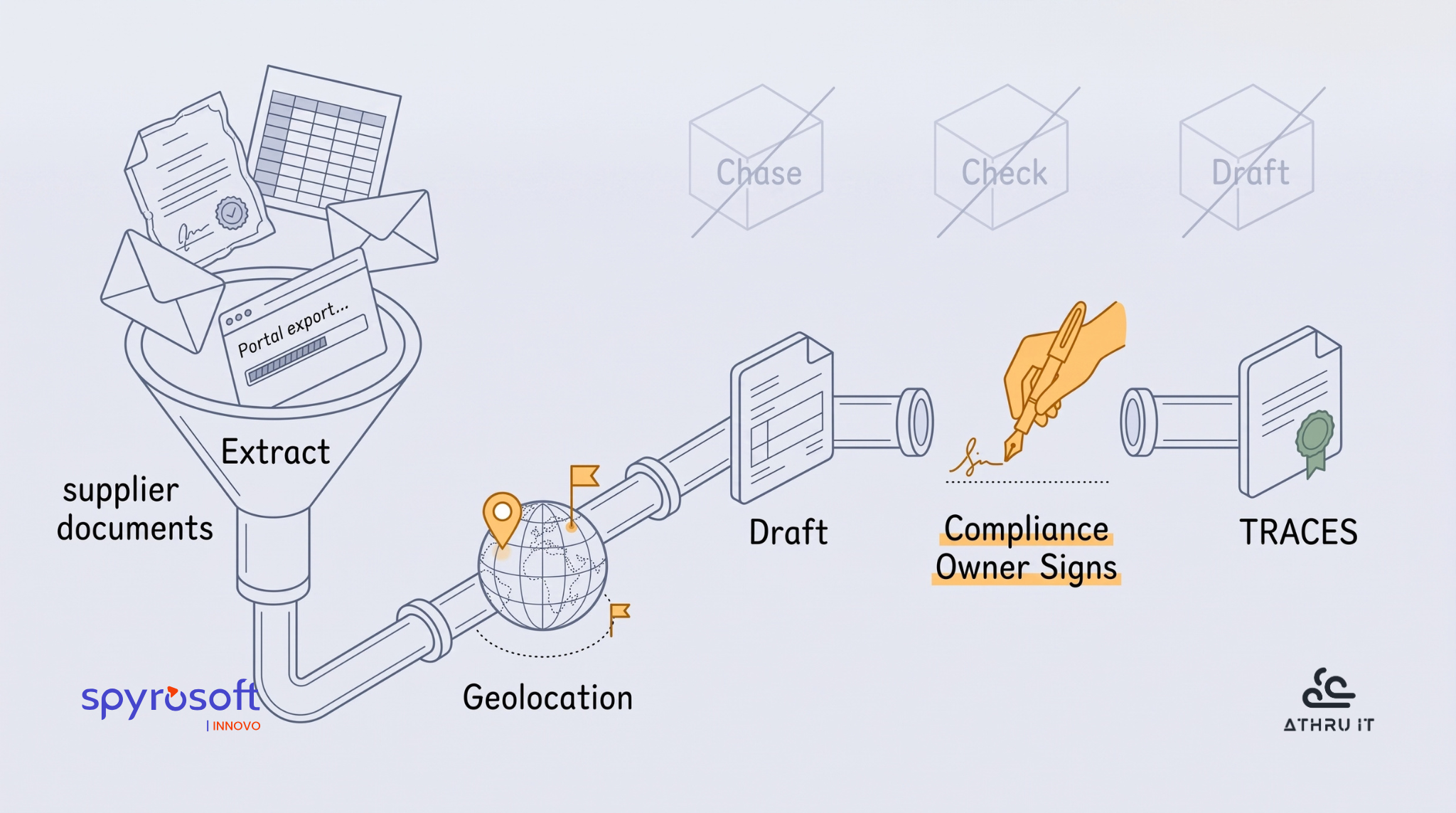
TL;DR
Supplier document chasing, geolocation checks, and due diligence statement drafting are one connected workflow, not three separate chores. An AI agent can extract the fields, check the coordinates, and draft the statement, but a human compliance owner must sign every statement before it reaches TRACES, because the legal accountability sits with that signature. Large and medium companies must comply from 30 December 2026, and the Commission's current confirmed position is no further delay, though that is a current reading rather than a permanent guarantee.
EUDR Automation Means One Workflow, Not Three Separate Chores
Most teams preparing for the EUDR run three jobs in parallel. One person chases suppliers for documents. Another checks the geolocation coordinates behind each consignment. A third drafts the due diligence statement when the deadline forces it. These usually sit with different owners and different tools, and they feel like three separate compliance chores.
They are not. They are one connected data flow: the same supplier information that proves where a commodity was grown is the information that fills the due diligence statement and the information a risk assessment reads. Seeing that flow as a single pipeline is where EUDR automation earns its place, because an AI agent can compress the mechanical parts of it, extract the fields, run the checks, draft the statement, and leave the one step that actually carries legal weight to a person.
That honest framing is the part current vendor pages leave out. The market foregrounds near-full automation of the workload and underplays that the signature must come before the statement is submitted. The decision in front of you is narrower and more practical than any product demo: which parts of this work can you safely hand to software now, and which still need your own sign-off. This piece answers that, in the compliance owner's own terms.
The Honest EUDR Automation Mechanism: Extract, Draft, Human Signs
Here is what an AI agent actually does in this workflow, stated plainly. It reads the heterogeneous documents your suppliers send, the PDFs, spreadsheets, emails, and portal exports, and extracts the fields the due diligence statement needs. It runs the geolocation and plot-coordinate checks against the coordinates on file. It drafts the due diligence statement on a standard template. That is the core of EUDR due diligence automation, and it is real work taken off a person's desk.
Extraction is the part worth automating because it is the part that does not scale by hand. Supplier documents arrive in no fixed format: one sends a scanned certificate, another a spreadsheet of plots, a third a portal export with the coordinates in a column no two suppliers label the same way. Keying those into a statement by hand, consignment after consignment, is slow and mistake-prone, and it is exactly the kind of structured reading an agent is good at.
Here is what the agent does not do, stated with equal weight. It does not decide the final risk classification on its own, and it does not submit anything to the EUDR Information System, the TRACES-based register, without a human signature. The reason is not caution for its own sake.
By submitting the due diligence statement, the operator formally assumes legal responsibility for the product's compliance, and the accountability for a false or incomplete statement sits with whoever signs it, not with the software that drafted it.
That is why human in the loop compliance here is a legal fact about the regulation, not a preference we happen to hold.
So the shape is extract, draft, human signs, in that order. The agent does the reading and the drafting at machine speed and machine consistency. A named compliance owner then reads the draft, applies judgement to the risk picture, and signs, and only then does the statement move. In a well-built workflow, nothing lets a statement reach TRACES unsigned.
We have built document-extraction systems of this class before, in other regulated industries, reading structured fields out of inconsistent source documents and handing a reviewer a clean draft to check. That is the adjacent experience behind the mechanism here: a class of work, not an EUDR project, and it changes nothing about who signs. The value of automation is in the hours it removes from the extract-and-draft stage, not in removing the person whose signature is the whole point.
The 30 December 2026 EUDR Deadline, and Why 'No Further Delay' Is Not a Permanent Guarantee
The durable fact is simple and you can plan on it: large and medium operators and traders of the seven in-scope commodities must comply with the EUDR from 30 December 2026. Micro and small operators follow from 30 June 2027, and the micro and small businesses already covered by the earlier EU Timber Regulation stay under it from 30 December 2026. The regulation is Regulation (EU) 2023/1115 on deforestation-free products. That date, 30 December 2026, is the one your planning runs against, and it is the EUDR compliance deadline this whole workflow is built to meet.
The part that needs care is the phrase "no further delay". This date has already moved twice, from an original date near the end of 2024, to the end of 2025, to the current 30 December 2026. That history is why the deadline is a live political question rather than settled fact, and it is why we treat the current position as exactly that, current.
The Commission's current confirmed position is that there will be no further delay. On 13 July 2026 it restated the 30 December 2026 date and published its four final implementation tools, which is the clearest official signal that implementation is proceeding on schedule.
The Commission "does not favour another reopening of the EUDR."
Read together, those are solid grounds to plan for the date holding.
They are not a permanent guarantee, and no one should present them as one. There is no single official sentence ruling out a future delay; the support is the Commission acting as though the date stands and a legal reading of its position, not a signed promise that it can never change. For a deforestation-free supply chain programme being scoped now, the honest planning assumption is this: build for 30 December 2026, and treat the no-further-delay position as the best current reading, re-checked close to the moment you act on it. In practice that means the automation you scope should earn its keep against the date as it stands, not against a delay you are hoping for.
Inside the Workflow: From Supplier Documents to a Signed Due Diligence Statement
Follow one consignment through the workflow and the connected data flow becomes concrete.
It starts with supplier data. Heterogeneous documents arrive, the PDFs, spreadsheets, emails, and portal exports, and the required fields are extracted from them: supplier identity, commodity, quantity, the country and region of production, and the geolocation of every plot it came from. This is where EUDR supplier data AI does its first useful work, turning inconsistent documents into a structured record a person can check rather than retype. For a commodity sourced from many smallholders, a single shipment can carry many plots, and that is where checking by hand breaks down.
Next come the plot coordinates. The EUDR requires the geolocation, the latitude and longitude plot coordinates, of all plots where the relevant commodities were produced. EUDR geolocation automation checks those coordinates for the obvious failures:
- missing points
- coordinates that fall outside the stated country
- polygons that do not resolve
It flags what a reviewer needs to look at; it does not quietly decide that a questionable plot is fine.
Then the risk assessment runs. Due diligence under the regulation has three elements:
- collecting the information
- assessing the risk
- mitigating it where the risk is not negligible
The agent can assemble and present the risk picture from the data gathered. The classification itself stays with the compliance owner, because that judgement is part of what the signature stands behind.
Only then is the statement drafted. To automate the EUDR due diligence statement is to fill a standard template from the structured record and the risk assessment, ready for review. The draft is complete, consistent, and traceable back to the supplier documents it came from, and it is still a draft until a person signs it.
A word on traceability: the vocabulary matters to readers who will check it. The one-up, one-down traceability principle, knowing one step back who you bought from and, for traders, one step forward who you supplied, is not an EUDR invention. It is the long-standing record-keeping baseline of Article 18 of the EU General Food Law Regulation (EC) 178/2002, which a compliance owner already knows from food-safety work. What the EUDR layers on top of that familiar baseline is plot-level geolocation.
Set the before and after side by side. Today, for many teams, this is three disconnected chores: someone chases documents, someone else validates coordinates in a separate tool, and the statement gets drafted by hand against a deadline, with slow, lossy hand-offs between them. With the connected workflow it is one data flow: supplier documents in, a structured and checked record through the middle, a drafted statement out, and a single human review at the end.
That last step does not move. The compliance owner reviews and signs before the statement is submitted to the EUDR Information System, because the legal accountability for it rests on that signature, not on how the draft was produced.
Why This Reads Differently From Current EUDR Automation Vendor Pages
If you have read a few EUDR automation vendor pages, the honest version above will feel different, and it is worth being precise about why.
The typical EUDR compliance automation software page follows a recognisable shape:
- It pitches full or near-full automation of the due diligence workflow.
- It quotes a headline efficiency figure; one page promises to cut preparation time by up to 80%, with no method or source behind the number.
- It stays largely quiet on the one question a compliance owner cares about most: who reviews and signs the statement before it is submitted.
The point is not that these tools mention no human at all. They are getting better at it. At least one vendor page now states plainly that a senior leader must sign and validate each statement and take legal accountability for its accuracy. So the honest differentiator is precision, not novelty. We are not claiming to be the only ones who mention a signature. We are saying something narrower and checkable: the sign-off is required, it happens before submission, and it is described in the compliance owner's own vocabulary rather than buried in a feature list.
That precision is defensible because the sign-off is not a marketing choice, it is a regulatory fact. The operator who submits the due diligence statement assumes legal responsibility for the product's compliance, which is what makes the signature the load-bearing step rather than an optional review. A page that implies otherwise is not describing a more advanced product; it is describing a workflow the regulation does not allow.
This is also where EUDR AI agents are easy to oversell. An agent that extracts fields, checks coordinates, and drafts a statement is genuinely useful. An agent presented as deciding the risk and submitting on your behalf is describing the exact step that carries your legal exposure, and no efficiency figure is worth that trade. The useful question for any tool is which steps it leaves to you, and whether it says so.
We have delivered document-extraction work of this class in other regulated industries, where the same pattern holds: the software reads the inconsistent inputs and drafts, and a qualified person owns the decision and the sign-off. That is the adjacent track record behind the mechanism, kept deliberately apart from the regulatory facts above, which stand on their own sources rather than on anything we have done.
Before You Scope an EUDR Automation Pilot, Audit the Manual Fields First
The whole argument comes down to one line: this is a single connected workflow, and the human sign-off is the step that matters before 30 December 2026. Automation can take the mechanical weight off the extract-and-draft stage and leave that signature exactly where the law puts it, with a named person who reads the draft and owns the decision.
So the practical first move is not to buy a tool. Before you scope an EUDR automation pilot, audit which supplier-document fields your compliance owner currently keys in by hand for every due diligence statement. That list, the fields that are slow, repetitive, and error-prone to enter by hand, is the real scope of a pilot, whether you run it yourselves or bring in outside help to scope it. Start there, and the rest of the decision gets a good deal clearer.
FAQ
When does the EUDR deadline apply to large and medium companies?
Large and medium operators and traders of the seven in-scope commodities must comply with the EUDR from 30 December 2026. Micro and small operators follow from 30 June 2027. The date is set in Regulation (EU) 2023/1115 as amended.
Has the EUDR deadline been delayed again?
The deadline has moved twice already, from an original date near the end of 2024 to the end of 2025 and then to 30 December 2026. As things stand, the Commission's current confirmed position is no further delay: it restated the date and issued its four final implementation tools on 13 July 2026, and a named legal analysis reports it "does not favour another reopening of the EUDR". There is no single official sentence ruling out a future change, so treat the date as firmly current rather than permanently fixed.
What can be automated in EUDR due diligence?
The mechanical parts. An AI agent can read heterogeneous supplier documents and extract the required fields, check the geolocation plot coordinates, and draft the due diligence statement on a standard template. What it cannot do on its own is decide the final risk classification or submit the statement without a human signature.
Can AI generate an EUDR due diligence statement?
It can draft one. Filling a standard due diligence statement template from the extracted supplier data and the risk assessment is well within what current tools do. It is still a draft until a compliance owner reviews and signs it, because submitting the statement is what assumes legal responsibility for the product's compliance.
Does EUDR automation software still require human review before submission?
Yes. By submitting the due diligence statement, the operator assumes legal accountability for its accuracy, so a named person must review and sign before it reaches the EUDR Information System. Software that drafts the statement does not carry that accountability; the signatory does.
What is a due diligence statement under EUDR?
It is the statement an operator submits, in the EUDR Information System built on TRACES, before placing an in-scope product on the EU market, confirming that due diligence has been carried out and the risk of non-compliance is negligible. The due diligence behind it has three elements: collecting the information, assessing the risk, and mitigating it where needed.